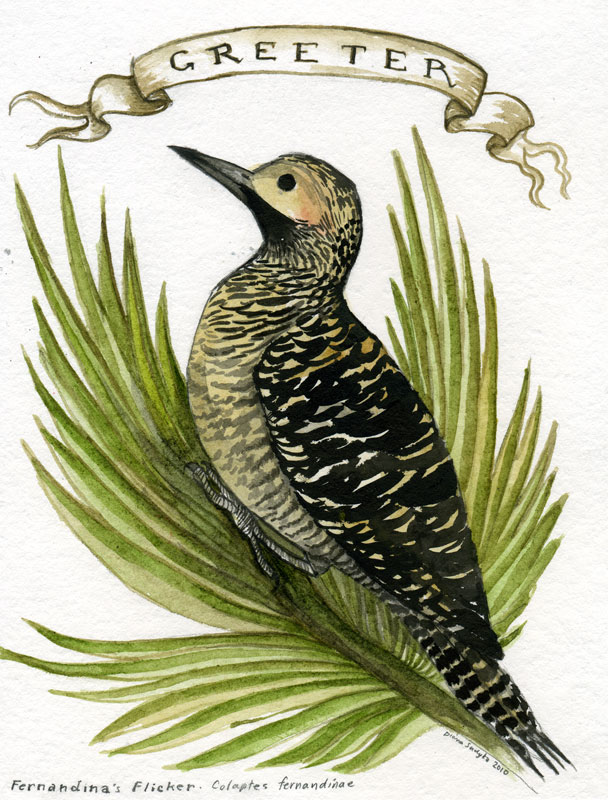
I recently was asked to create a painting of a Dovekie (Alle alle) and Fernandina's Flicker. Both are very interesting birds. They are very different from one another, so I will post about the Dovekie separately.
Here in the States we have two species of flicker: Northern Flicker (Colaptes auratus), and Gilded Flicker (Colaptes chrysoides). It was once thought that Gilded was a subspecies of the Northern, but recent research has shown them to be different species. Flickers are rather large woodpeckers that, unlike some of the other members of the Picidae family, tend to favor foraging on the ground. They use their strong bills to probe in to the ground and stir up ants, grubs and other invertebrates. There's a dusty, flat patch of ground in my neighbors yard that is frequented by a few during the spring and summer for this purpose.
Fernandina's Flicker is a species that is endemic to Cuba. It's population has been hovering around 600 to 800, making it one of the rarest woodpeckers in the world. Like their North American counterparts, Colaptes fernandinae, like to forage on the ground. As far as appearance, they share some similar traits with the Northern and Gilded, but are quite distinct. I told Dave Willard at the Field Museum (bird collections manager that I volunteer for) that I had a commission to do a small painting of the Fernandina, and this resulted in him helping me find the few study skin specimens in the collections. These are specimens that were collected many, many years ago. Its status in the wild is so unstable due to low numbers, and constant threats from habitat loss, that collecting any specimens these days is out of the question. The photo above is of the backside and tails of these specimens. The plumage patterning is striking. Our flickers have similar patterning,but not quite as bold as what you see on the Fernandina's here. The other image is the painting I made. There is a sweet story behind the name "Greeter" in the banner, but for the sake of client privacy, I won't go in to details.